Updated July 2026
Vertical Blinds for Patio Doors: Sizing, Fabric, and Installation Guide
Vertical blinds are still the most practical option for a standard sliding patio door. Here's how to spec them without ending up with a rattling, sagging mess.
By Hayati, owner-operator · Published
Get a Free Quote on WhatsApp
Send a photo of your window and get an estimate within 1 hour.
Vertical blinds have an image problem left over from the 1990s. The new fabric-vane and PVC-alternative options look nothing like the yellowed plastic in your grandmother's basement, and for a standard 6-foot or 8-foot sliding patio door they remain the most practical choice: full opening, no fabric to fold on the floor, and a fraction of the cost of drapery.
Here's how to spec a set that lasts.
Sizing — the two measurements that matter
Width: measure the total opening including the trim (outside mount) or just the inside frame (inside mount). For patio doors we almost always outside mount 4–6" wider than the door on each side, so the vanes can stack completely clear when open. Nothing kills the view like vanes bunched in front of the glass.
Height: measure floor to top of frame, then subtract 1/2" clearance so the vanes don't drag. Standard vane length is 84" — for taller openings, ask for 91" or custom.
Fabric vs. vinyl vs. PVC
Fabric vanes look the best and hang cleanly. Best for living-room patio doors. $220–$360 for a standard 6-foot door installed.
PVC/vinyl vanes are durable, wipeable, and cheap. Best for kitchens, basements, and rental units. $180–$260 installed.
Faux-wood vertical blinds exist and look great on wide openings, but they're heavy and expensive ($550–$900 installed). Only worth it on estate-home patio doors.
Stacking — left, right, or split
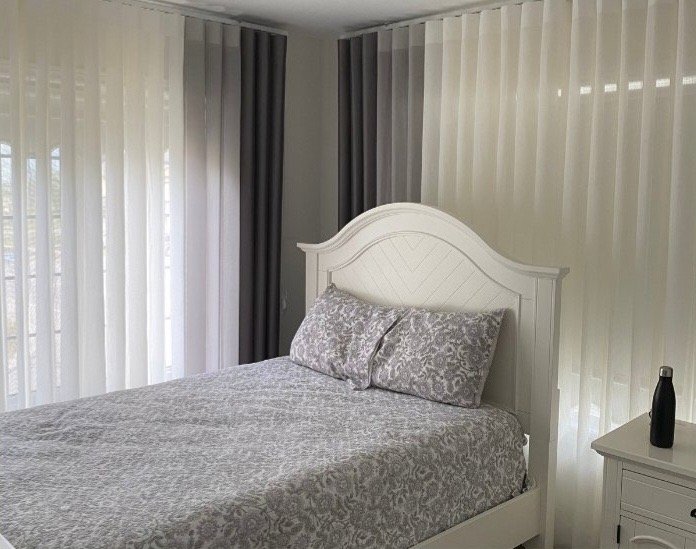
"Stacking" is which way the vanes gather when open. Match it to how the door operates: if the door slides right-to-left to open, stack the vanes on the left so they clear the glass. Split-stack (vanes part in the middle) looks great on French sliders and adds no cost.
Chain vs. wand control
Wand control (one plastic wand you turn to tilt, then slide to open) is the current standard and included in almost every quote. Cordless, child-safe, and quiet.
Chain and cord is still an option for very wide openings (over 10 feet) where the wand physics get awkward. Add child-safety tensioners if you go this route.
Installation notes
Track height matters. On outside-mount installs we hang the track 4–6" above the frame, so when the vanes are tilted open you get the full door height clear.
Level matters more than square. A track that's 1/8" out of level makes the vanes swing on their own — a common issue in older GTA homes where the header settles.
A whole-home patio door install is usually done in 30–45 minutes.
Alternatives worth mentioning
Panel track shades: a modern alternative that slides horizontally on a track like closet doors. Nice on very wide (>10 ft) openings. About 20–30% more than fabric vertical.
Motorized wide-panel zebra: a single wide zebra blind on a motor. Beautiful, expensive ($900–$1,400 for a 6-foot door), and only makes sense if you want to match the zebras elsewhere in the room.
Frequently asked questions
- Do vertical blinds rattle in the wind?
- Not with the proper weighted hem chain and correctly-sized track. Cheap vertical blinds rattle; properly-installed ones don't.
- Can I replace individual damaged vanes?
- Yes — that's one of the best things about vertical blinds. Order a matching vane and swap it in five minutes.
- How wide can vertical blinds go?
- A single track goes up to about 144" wide. Beyond that we split it into two tracks or switch to panel-track shades.
Get a Free Quote on WhatsApp
Send a photo of your window and get an estimate within 1 hour.