Updated July 2026
Custom Blinds for Toronto & Scarborough Condos: A Buying Guide
Building rules, cordless and child-safe mechanisms, motorised options for windows you can't reach, and how to measure around radiators and balcony doors in a Toronto or Scarborough condo.
By Hayati, owner-operator · Published
Get a Free Quote on WhatsApp
Send a photo of your window and get an estimate within 1 hour.
Condo windows are their own category. The glass is usually bigger than in a house, the frame recess is shallower, there's often a balcony door on the same wall, and above all there's a set of building rules deciding what you're allowed to hang. Add a radiator or fan-coil unit under the window and a heat-tracked ceiling, and a product that works beautifully in a Scarborough bungalow becomes the wrong answer twelve floors up.
This guide covers what actually matters when you're buying custom blinds for a condo across Toronto, Scarborough and the surrounding GTA: building bylaws and aesthetic rules, cordless and child-safe mechanisms, when motorising is worth it, how to measure around radiators and balcony doors, and which two products cover most condo situations. Owner-operated custom window coverings across the Greater Toronto Area — bbased in Ajax, serving Durham Region, York Region, and East Toronto.
Building rules: check these before you order
Most condo corporations have something in the declaration or rules about window coverings, and it's almost always about what the building looks like from the street. The common requirement is a neutral backing — white, off-white or light grey — on anything visible through the glass. Some newer downtown Toronto buildings go further and specify the exact backing colour, and a handful in the Scarborough Town Centre and Kingston Road corridors specify that nothing may be mounted to the exterior frame.
The second thing to check is contractor access. Many buildings require a Certificate of Insurance from anyone doing work in a unit, and most require you to book the service elevator for delivery. We carry $2M liability insurance and email the COI to your property manager ahead of the install at no charge — but the elevator booking is yours to make, and in busy buildings that's the step that adds a week.
If you're renting, ask your landlord before drilling anything. Inside-mount cassettes fix into the window frame with small screws and are straightforward to remove and patch at the end of a lease, which is why they're the usual choice for rentals. Tension-fit and adhesive products exist but they sag on wide condo glass, and we don't recommend them.
Cordless and child-safe mechanisms
Health Canada's corded window covering regulations took effect in May 2022 and effectively ended the sale of blinds with accessible pull cords in Canada. That's a straightforward good thing in a condo, where the sofa and the crib often sit right under the window.
In practice you have three compliant options. A continuous-loop chain with a tensioner screwed to the wall keeps the chain taut so there's no loop a child can pull down — it's the standard for zebra blinds and rollers, it's inexpensive, and it works. A spring-operated cordless roller has no chain at all: you pull the bottom bar and it stays where you put it. And a motorised shade has no operating mechanism in the room whatsoever.
For a condo with young children, our default recommendation is cordless spring rollers in the bedrooms and either chain-with-tensioner or motorised in the living areas, depending on the height of the glass.
Motorised blinds for windows you can't reach
Motorising isn't a luxury add-on in every condo — sometimes it's the only sensible answer. Two-storey glass in a loft, a shade above a fixed radiator you can't stand in front of, or a wide living-room panel where reaching the chain means climbing over furniture are all cases where a motor pays for itself in daily use.
Rechargeable battery motors are what nearly every condo ends up with, because running power to a window in a finished unit means opening a wall. A battery tube charges by USB every 8–12 months depending on how often the shade runs, and it doesn't need any electrical work or building approval. Hardwired motors are cleaner but really only make sense during a full renovation.
Budget roughly $450–$900 per window installed for motorised, depending on width. One remote can drive several shades as a group, so a wall of glass split into three panels still operates with one button. Our motorised blinds page covers the mechanisms in more detail.
Measuring around radiators, fan-coils and balcony doors
This is where condo measuring gets specific, and it's why we measure on site rather than working from a photo.
Radiators and fan-coil units sitting under the window usually mean the shade has to stop above the unit rather than reaching the sill, or be mounted outside the recess so it hangs in front. Either is fine — the important part is deciding before the fabric is cut, because a shade that ends two inches into a heater is a shade you can't lower.
Balcony and patio doors on the same wall as fixed glass need to operate independently. The standard solution is a separate shade on the door, so opening the door doesn't drag the living-room shade with it. Fabric vertical blinds still make sense on wide sliders; a single wide roller works if the door is a swing type or you rarely use it in summer.
Shallow frame recesses are the third condo constant. Many towers have 1–2 inches of depth, which is enough for a slim cassette but not for a bulky headrail. If yours is too shallow for an inside mount, an outside mount on the drywall above the frame is the answer and it looks deliberate when the overlap is sized correctly.
Roller shades vs. zebra blinds for condo use
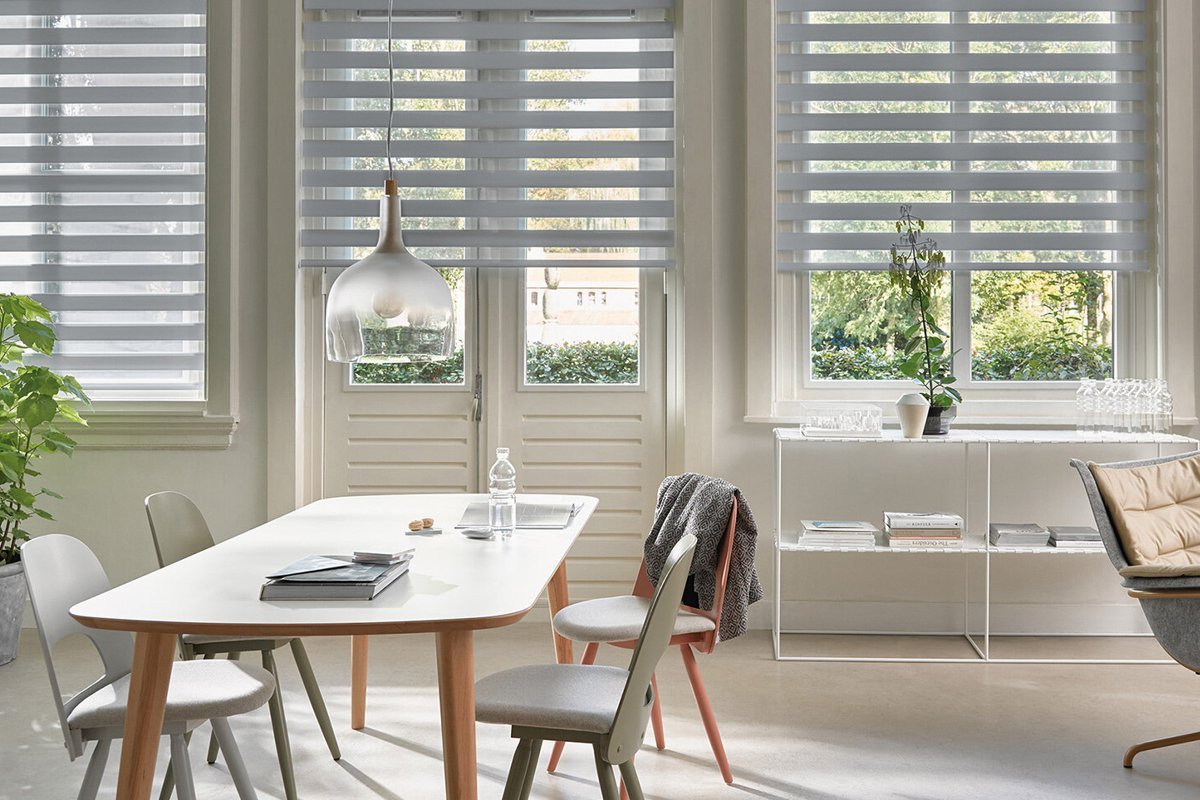
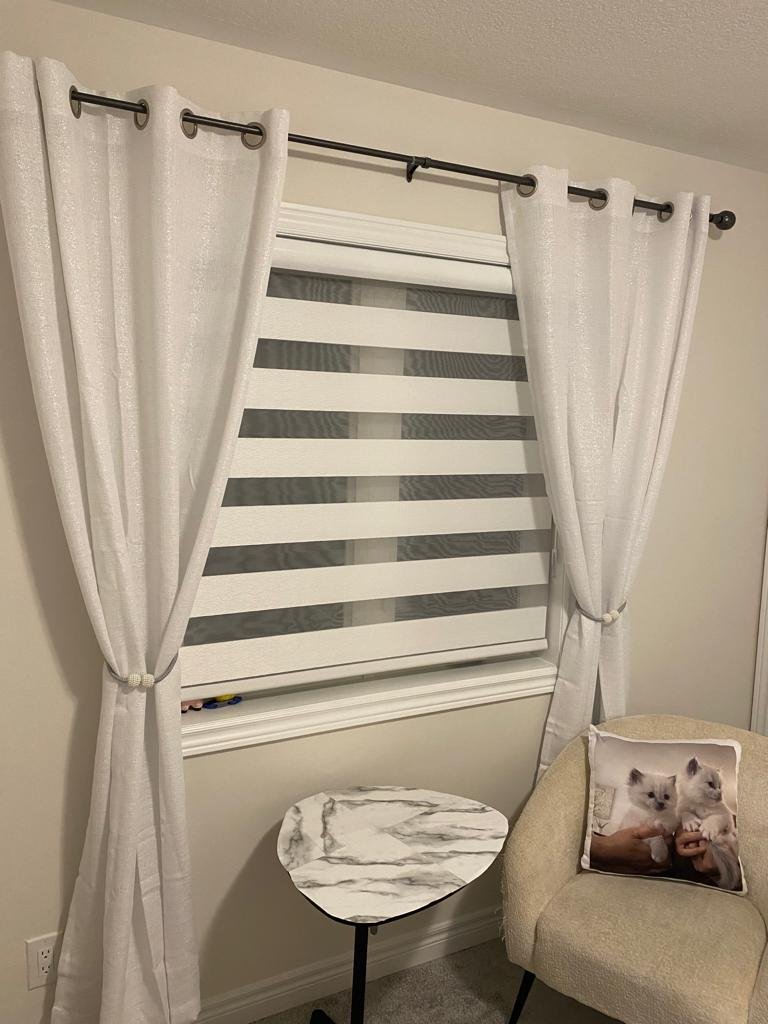
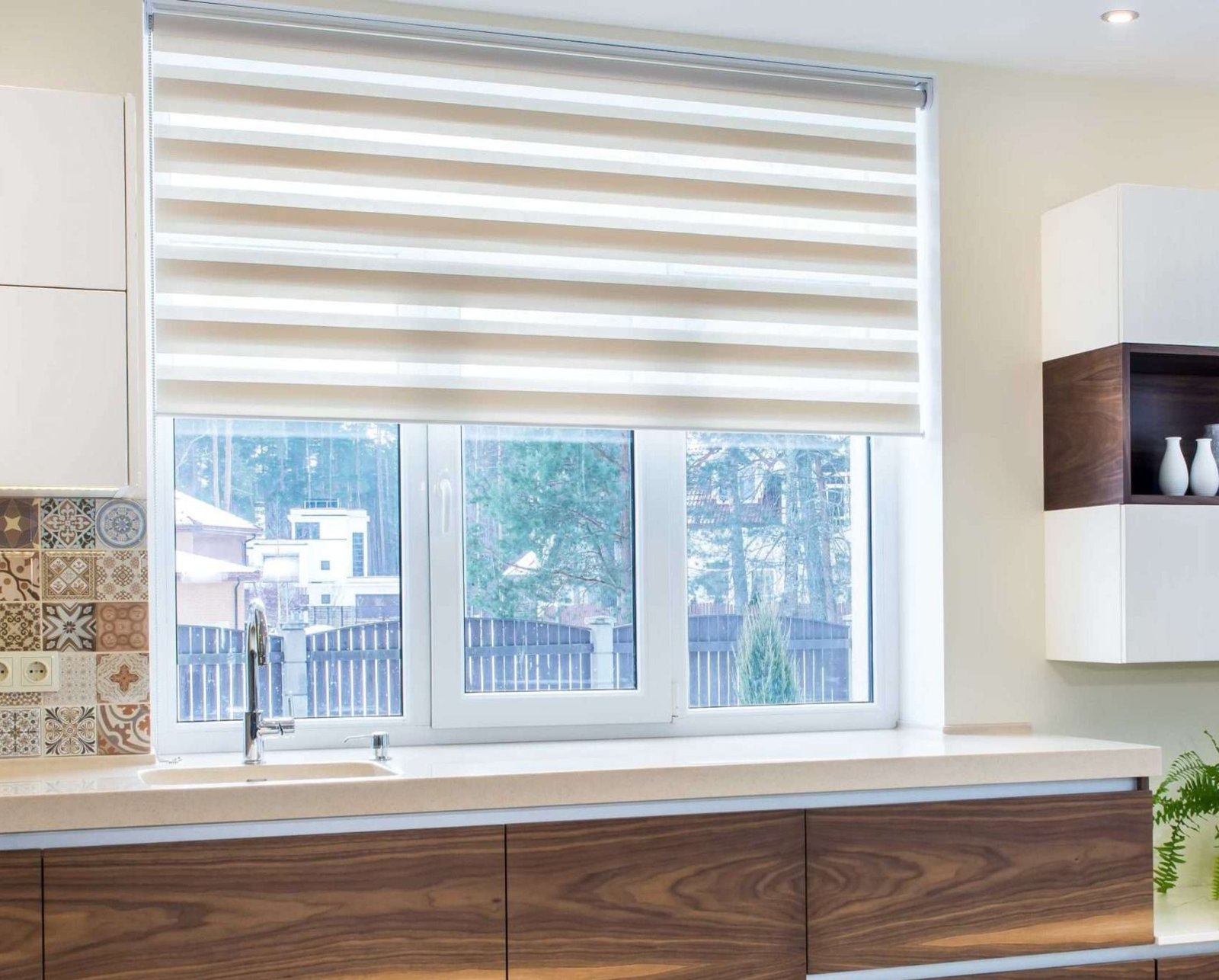
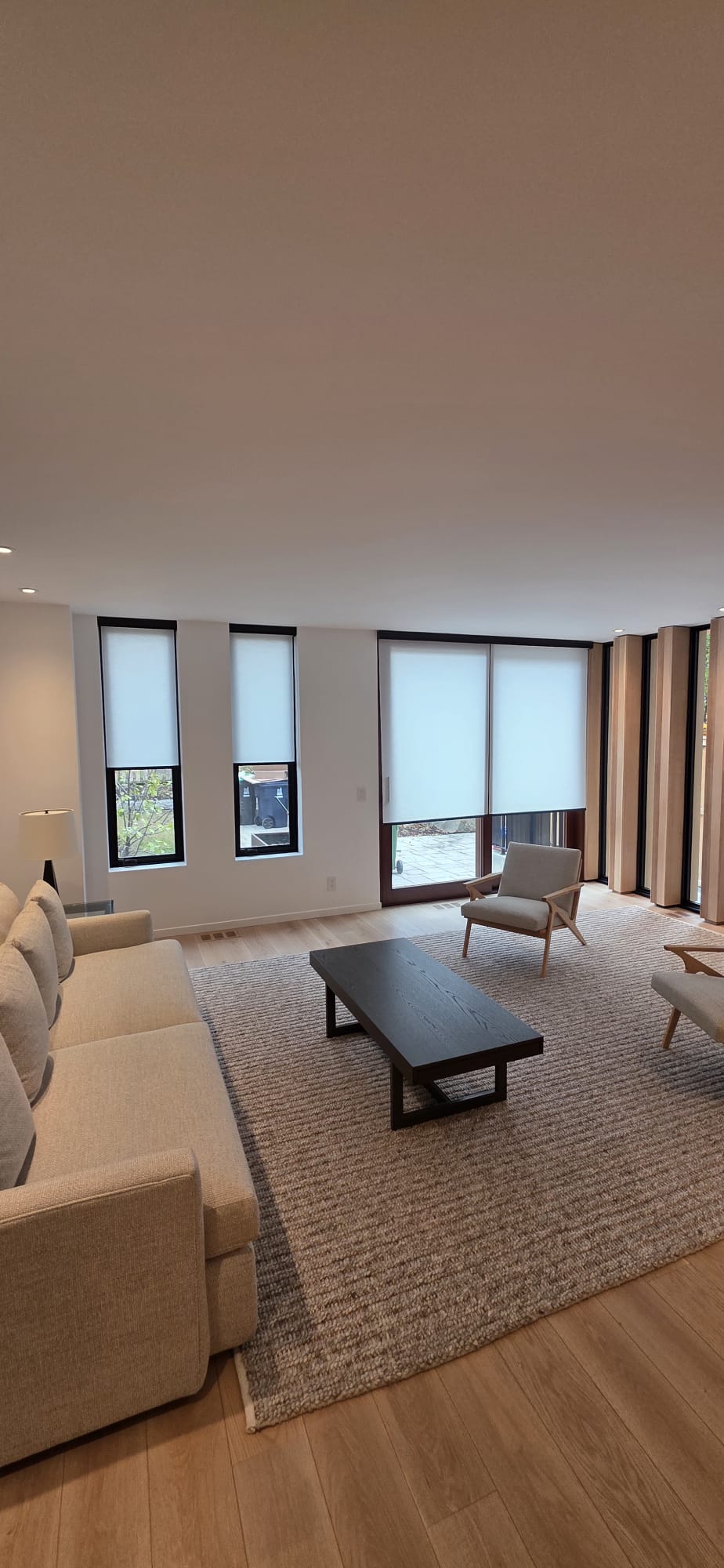
Two products cover the large majority of condo jobs we do. Roller shades are the simplest: one fabric, one tube, the fewest parts to fail, and the only realistic option when you need genuine blackout in a bedroom. Zebra blinds give you adjustable privacy and filtered light in a single shade, which is what you want in a living room you use all day.
The table below is the comparison we walk through at almost every condo consultation.
| Consideration | Zebra blinds | Roller shades |
|---|---|---|
| Best room | Living, dining, den — used all day | Bedrooms, media rooms, screen-facing windows |
| Light control | Adjustable: sheer-to-solid in one second | Fixed by fabric: sheer, light-filtering or blackout |
| True blackout | Not without side channels or a second shade | Yes, with blackout fabric and side channels |
| Installed price per window | $180–$320 | $170–$300 |
| Stack depth when open | Slim cassette, needs ~2" recess | Slim cassette, works in shallow recesses |
| Cleaning | Vacuum brush; bands can crease if forced | Wipe down; very low maintenance |
| Motorises well | Yes | Yes |
What a condo job costs and how long it takes
Installed pricing in a condo is the same as anywhere else we work: roughly $170–$300 per window for roller shades, $180–$320 for zebra blinds, $220–$400 for fabric verticals on a slider, and $450–$900 for motorised. That's one price per window including fabric, hardware, custom manufacture and installation. No measure fee, no travel charge.
Timeline is where condos differ slightly. You'll get a ballpark within an hour of sending a WhatsApp photo, an in-home consultation within a couple of days, and manufacturing takes 7–15 business days. The extra step is your building's elevator booking and COI approval, which we start as soon as you approve the quote so it isn't the thing holding up install day. Most condo installs finish in a single 1–2 hour visit.
Get my price range
Three fields, instant installed price range from our published pricing — then send it straight to Hayati on WhatsApp. Typical reply time: under 1 hour.
Keep reading
Frequently asked questions
- Does my condo board have to approve my blinds?
- Usually you don't need formal approval, but most declarations require a neutral backing visible from outside, and many buildings require a Certificate of Insurance from the installer plus a service elevator booking. We check the rules before ordering and send the COI to your property manager at no charge.
- Are cordless blinds required in Canada?
- Health Canada's corded window covering regulations took effect in May 2022 and effectively ended the sale of blinds with accessible pull cords. Everything we install is compliant — cordless spring rollers, chain-and-tensioner systems, or motorised.
- Can I put blinds in a rented condo?
- Yes, with your landlord's permission. Inside-mount cassettes use small screws in the window frame and come out cleanly at the end of a lease. We don't recommend tension or adhesive mounts on condo glass — they sag on wide windows.
- What if there's a radiator under my window?
- We either stop the shade above the unit or mount it outside the recess so it hangs in front. It's a decision we make on the measuring visit, before the fabric is cut, so the shade always operates fully.
Get a Free Quote on WhatsApp
Send a photo of your window and get an estimate within 1 hour.