Updated July 2026
Blackout Roller Shades for Bedrooms: What Actually Blocks Light
Not all "blackout" blinds are actually blackout. Here's what the fabric label means, why the edges matter more than the middle, and what to specify on your quote.
Get a Free Quote on WhatsApp
Send a photo of your window and get an estimate within 1 hour.
"Blackout" is one of the most abused words in the window covering business. Most fabrics sold as blackout are actually room-darkening — they block the fabric-facing light, then let a bright halo through around the edges. If you're a light sleeper or have a west-facing bedroom in an Ajax or Whitby two-storey, that halo is what wakes you up in June.
Real blackout is a fabric choice and a hardware choice together. Both matter.
The fabric side
A true blackout fabric is either an acrylic-coated woven or a triple-weave. Hold a sample up to a 60W bulb — if you see any glow through the middle of the fabric, it's not blackout, it's room-darkening. Real blackout is a solid black silhouette.
Most manufacturers we work with carry 6–12 legitimate blackout colours (whites, greys, and warm neutrals). The fabric adds $40–$80 per window over a light-filtering option.
The edges are 80% of the fight
Even a perfect blackout fabric leaks light where the shade meets the window frame. On a standard inside-mount roller, the fabric is 3/8" narrower than the window opening on each side — that's the light gap you see at sunrise.
There are three ways to close it. Side channels (U-shaped tracks screwed to the window frame): near-total blackout, adds $40–$70 per window. Outside mount (shade extends past the frame): easy fix, but you lose the clean inside-mount look. Wrap-around fabric (curved fabric that closes the gap): works on some window styles but not all.
For bedrooms we almost always recommend side channels. Nothing else comes close.
Top and bottom
The top of the shade sits behind a fascia (cassette). A proper cassette closes the top light gap; a cheap open-roll setup does not. Ask for a closed cassette on any blackout order.
The bottom rests against the sill. If your sill is angled or bevelled, there will always be a small gap. A hem-bar seal (rubber gasket on the bottom rail) closes it. Adds about $30 per window.
What to write on your quote
"Blackout fabric, closed cassette, side channels both sides, hem-bar seal, inside mount." If your quote is missing any of those four, ask why. That's the spec that actually turns a bedroom dark.
Cordless and child safety
All blackout rollers we install for bedrooms are cordless as standard. Cordless costs the same as chain-operated and is the current Ontario child-safety standard for any room where a child sleeps. No exceptions.
One thing not to do
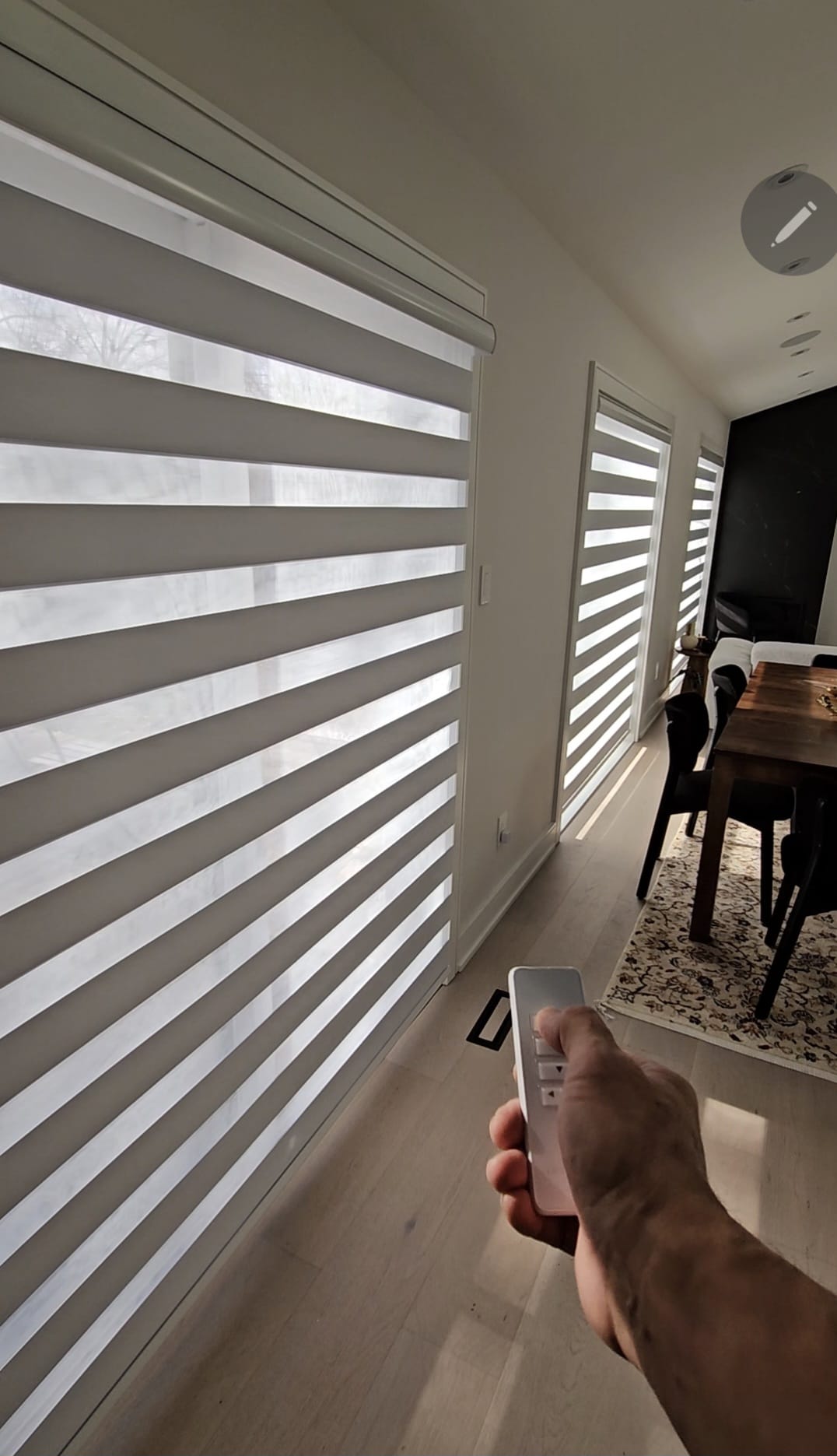
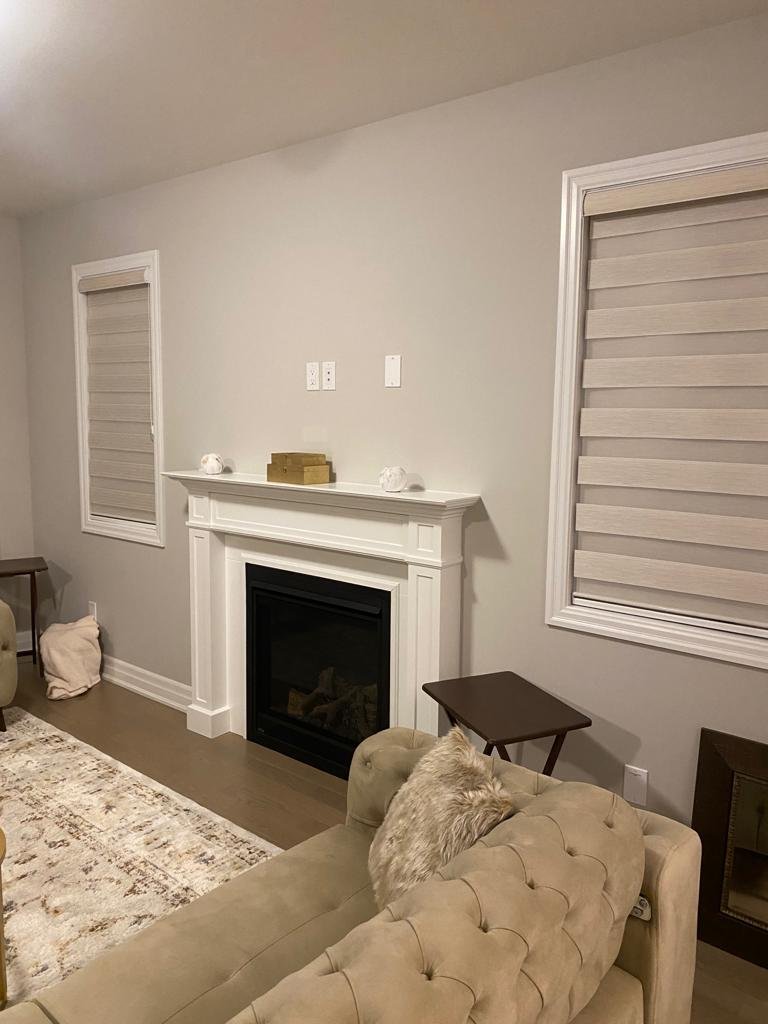
Don't order a "blackout zebra blind" for a primary bedroom and expect real blackout. Zebra blinds have horizontal band seams that always leak a little light. Zebra blinds are great — just not in the room where you need it dark. Put a blackout roller there and put the zebra somewhere else.
Frequently asked questions
- How much do blackout roller shades cost installed?
- In the GTA, budget $220–$360 per standard bedroom window, plus $40–$70 per window for side channels. A typical 3-bedroom home runs $900–$1,400 total.
- Do side channels look bulky?
- No — they're a thin U-track (about 3/4" wide) mounted flush inside the window frame. On a white or neutral frame they nearly disappear.
- Can I add side channels later?
- Technically yes, but the shade may need to be remade slightly narrower to fit inside the channels. Cheaper to spec it upfront.
Get a Free Quote on WhatsApp
Send a photo of your window and get an estimate within 1 hour.